
An exhibit by GTEC | Museum of Vancouver, Vanier Park, Vancouver | Opening January 8, 2027
What would your neighbourhood look like if it were designed for a century that will be shaped by the impacts of a changing climate?
GTEC and the Museum of Vancouver (MOV) invite you to find out. Opening January 8, 2027, at the MOV in Vanier Park, Neighbourhood in the 21st Century is a community-focused exhibit that asks residents across Metro Vancouver to look at the places they call home with new eyes — and to imagine what those places could become.
About the Exhibit
Neighbourhood in the 21st Century explores nine dimensions of daily community life — from the buildings we live in and the food we eat, to the streets we walk and the energy we use, to the safety, work, health, arts, and above all the sense of belonging that makes a neighbourhood a home rather than just an address.
Each of the nine banners presents evidence, ideas, and questions in a format that is substantive without being overwhelming. QR codes on each banner link to expanded content, including local examples, research, and resources for residents who want to take action in their own communities.
The exhibit is designed to be encountered in conversation. Trained community facilitators will be present during programming hours to answer the questions the banners raise — about climate resilience, about equity, about what it means to belong somewhere, and about what neighbours can do together.
The Nine Dimensions
The exhibit is organized around GTEC’s Nine Dimensions of Neighbourhood Life — a framework for understanding how neighbourhoods build climate resilience through their systems and, above all, through the social connections that hold those systems together.
| 01 | Built Environment | 02 | Food Systems & Waste |
| 03 | Mobility | 04 | Energy |
| 05 | Safety | 06 | Work |
| 07 | Health & Well-being | 08 | Arts & Culture |
| 09 | Habitat – The Integrating Dimension |
Illustrated by students of Fraser Academy, Vancouver
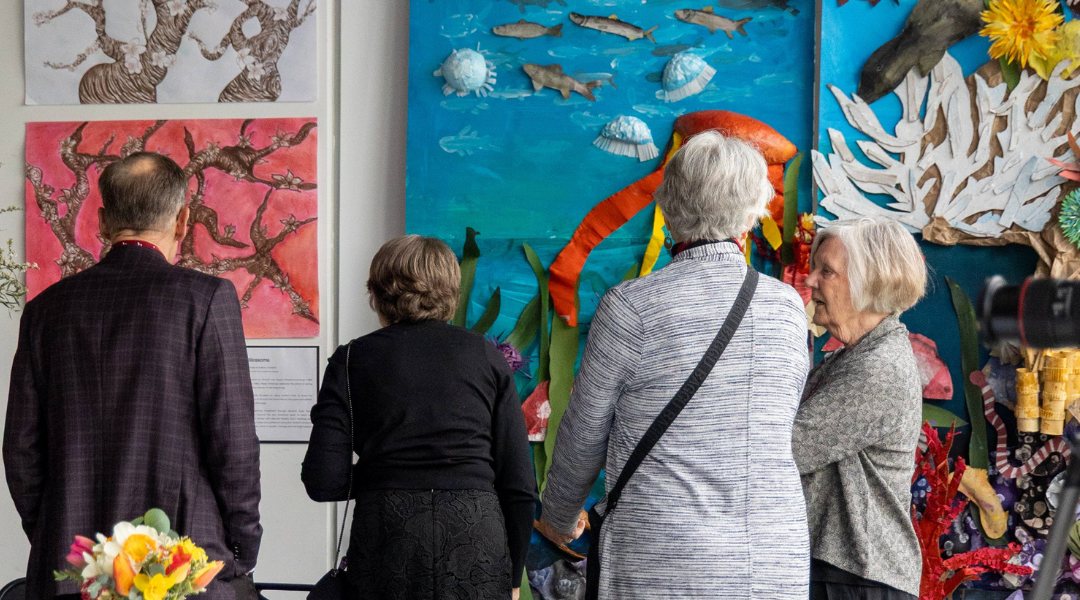
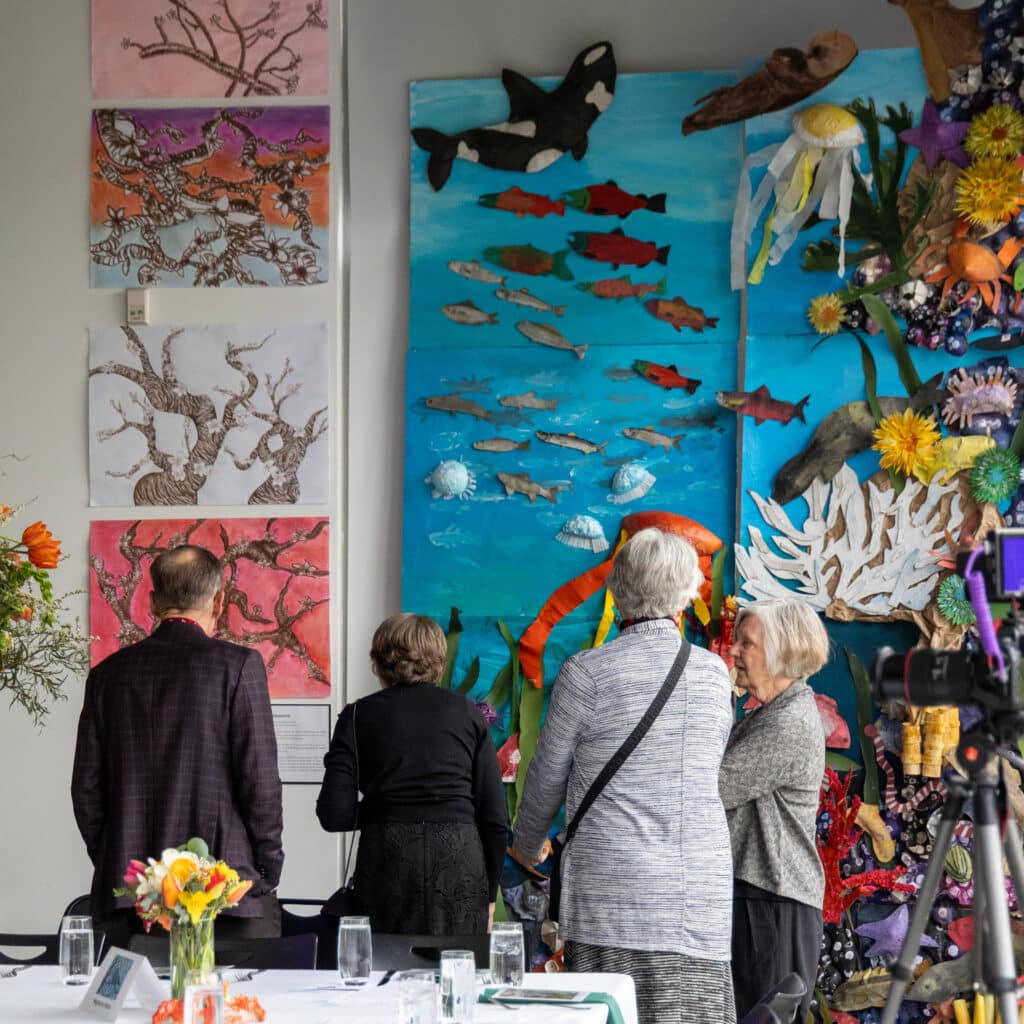
Each installation in the exhibit is brought to life through original illustrations by students from Fraser Academy, a Vancouver school whose dyslexic students learn differently and see the world with uncommon freshness and originality. Their artwork — honest, inventive, and full of the creativity that belongs to children — runs through the exhibit as a visual counterpoint to the data and the argument: a reminder of what neighbourhoods are ultimately for, and who will live in them longest.
The children’s illustrations do what no statistic can. They show the neighbourhood as a felt place — the garden, the street, the sky, the faces of neighbours — and they bring to the exhibit’s serious questions the creativity and innocence of eyes that have not yet learned to stop seeing what is possible.
The Neighbourhood Action Posters
Alongside the nine banners, the exhibit features Small Changes, an engaging, inspirational set of posters that introduce actionable categories of neighbourhood-scale climate action: Share, Lend, Reuse, Support, Nurture, Map, and Celebrate.
Where the nine banners make the case for neighbourhood climate resilience, Small Changes translates that case into daily life. Each category is a collaborative, practical activity that ordinary residents can implement on their block, in their building, or across their community — showing how the same action simultaneously reduces waste, builds climate resilience, and strengthens the social connections that hold a neighbourhood together.
That connection is the posters’ central insight: the most effective climate actions at neighbourhood scale are not solitary acts of individual virtue, but shared practices that build community as they go. Lending a tool, celebrating a harvest, mapping a local asset, supporting a neighbour in need — each is at once a climate act and a belonging act.
Opening Night – January 8, 2027
Join GTEC, the Museum of Vancouver, and the communities this exhibit is made for at the opening reception on Friday, January 8, 2027. The evening will include a facilitated walk-through of the nine banners, remarks from GTEC and MOV, and a dedication by an Indigenous Elder whose words will set the exhibit’s relational frame.
The opening is a community event, not a gala. It is designed for the residents, practitioners, educators, community leaders, and civic figures for whom neighbourhood-scale climate action is not an abstraction but a daily concern.
The Museum of Vancouver exists to encourage conversations about what Vancouver was, is, and can be. There is no more important conversation right now than the one about what our neighbourhoods will become in the face of climate change — and no better place to have it than here, with the people who live in them. ~ Ryan Hunt, CEO, Museum of Vancouver
Programming and Resources
Community facilitators trained by GTEC will be present during programming hours throughout the exhibit run to support visitor engagement with the exhibit’s content and discussion questions. A schedule of facilitated programming, including dimension deep-dives, school and community group visits, and a closing symposium, will be announced in the coming weeks.
The exhibit catalogue — a full-colour, professionally produced companion publication containing the exhibit’s complete content, expanded installation stories, and essays by the GTEC Media and Communications team — will be available for purchase at the Museum of Vancouver and for download at https://gteccanada.ca/.
About GTEC (Green Technology Education Centre)
GTEC is a Canadian charitable organization dedicated to neighbourhood-scale climate action. Through research, community engagement, and public education, GTEC develops frameworks, tools, and exhibits that help residents, organizations, and governments understand and build the climate resilience of the places people call home. Neighbourhood in the 21st Century is GTEC’s most ambitious public engagement initiative to date.
About the Museum of Vancouver
The Museum of Vancouver is Canada’s largest civic museum, located in Vanier Park on the traditional, ancestral, and unceded territories of the xʷməθkwəy̓əm (Musqueam), Sḵw̓wú7mesh (Squamish), and səl̓iĺwətaʔɬ (Tsleil-Waututh) Nations. Founded in 1894 and set against a spectacular vista of ocean, city skyline, and mountains, the MOV creates Vancouver-focused exhibitions and programs that encourage dynamic conversations about what Vancouver was, is, and can be.
A neighbourhood is not a collection of systems. It is a living place – and this exhibit is an invitation to build it well.
Contact Information
Media enquiries – GTEC
Arden Henley
info@gteccanada.ca
604-317-4128
Media enquiries – Museum of Vancouver
Ryan Hunt
rhunt@museumofvancouver.ca
604-730-5323
GTEC is a registered Canadian charitable organization. Registration number: 71841 9294 RR0001.
The Museum of Vancouver is located on the unceded territories of the xʷməθkwəy̓əm, Sḵw̓wú7mesh, and səl̓iĺwətaʔɬ Nations.
Sponsors and Partners
GTEC is grateful to our sponsors and partners – we couldn’t have done this without them. Visit our Neighbourhood in the 21st Century exhibit page to see a current list of our sponsors and partners.