
Book Review by Ross Thrasher
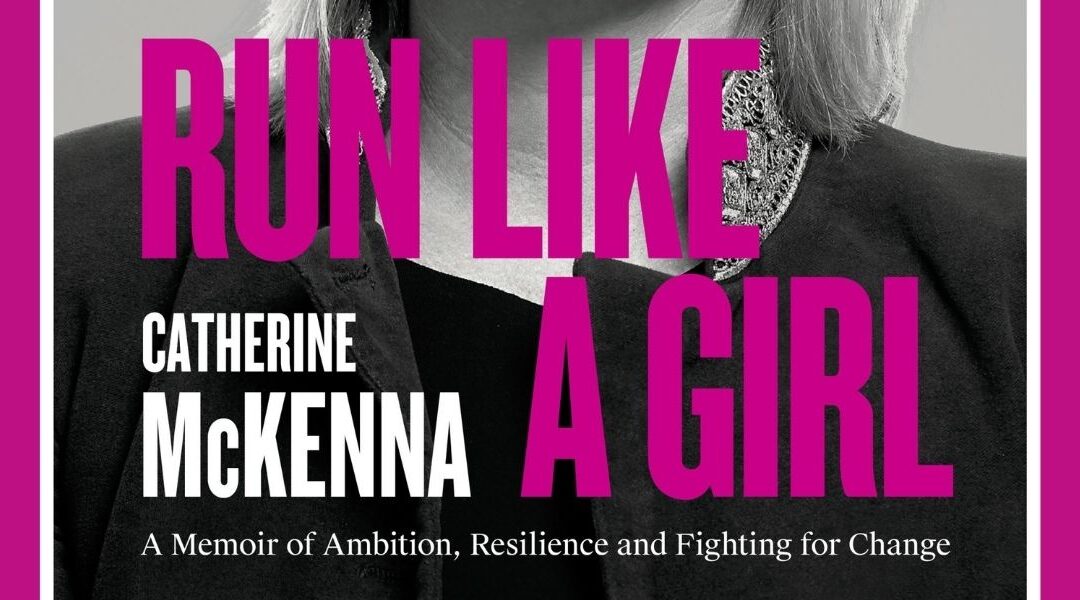
Run Like a Girl: a memoir of ambition, resilience and fighting for change, by Catherine McKenna. Sutherland House, 2025.
A competitive swimmer in her teens. A world traveler and UN representative in her 20s. A corporate lawyer, founder of a charity, and a mother in her 30s. A Liberal MP and Environment Minister in Justin Trudeau’s cabinet in her 40s. Catherine McKenna’s account of her life so far (she’s only 54) is absorbing, even inspiring. She portrays herself as a proud Canadian and an advocate for women and the climate movement.
Born and raised in Hamilton, Ontario, McKenna was a good enough swimmer to reach the Canadian nationals, but she couldn’t make Canada’s Olympic team. Still, she declares that the gruelling training and competition regimen in that sport taught her toughness, discipline, teamwork and the ability to cope with disappointment — qualities that would serve her well later. And throughout her life “swimming kept me sane”.
After studying international relations at the University of Toronto, McKenna backpacked around Southeast Asia in 1995. Her time in Indonesia was a highlight of that journey. Then a year at the London School of Economics, where she met her future husband Scott, followed by a law degree from McGill.
Catherine was delighted in 1998 when Scott was posted by the Canadian foreign service to Jakarta. She found work with a local law firm and learned the language. But Indonesia was in political turmoil after the ousting of its longtime autocratic President Suharto. The people of East Timor voted for independence, having been “brutally and illegally occupied by Indonesia since 1976”. As the Indonesian military resisted, the UN intervened to restore order. Later Catherine worked as a lawyer with a UN agency that helped the new nation of Timor-Leste renegotiate a maritime treaty with Australia. This experience whetted her appetite for “making a difference” in the political realm.
Back in Canada after 2002, McKenna found herself ill-suited for corporate law, but found joy in starting a family which eventually included three kids. During her first maternity leave, she got the idea of “launching a charitable organization to match Canadian lawyers and law students with governments and organizations in less developed countries needing legal expertise”. Canadian Lawyers Abroad was the result. Closer to home, McKenna developed a program called Dare to Dream which mentored Canadian Indigenous students toward careers in law and justice.
As a new mother in Ottawa, Catherine cultivated a network of fellow parents through book clubs, swim teams and other social connections. These came in handy as volunteers when she was persuaded to run for Parliament. The second half of Run Like a Girl recounts McKenna’s political career.
Admitting that she “loathed everything” about Stephen Harper and the Conservatives who were in power at the time, McKenna was attracted to the Liberals and their new leader Justin Trudeau. She decided to run in Ottawa Centre, which was a “safe” NDP seat in those days. It was a long slog to gain the Liberal nomination for the riding, followed by a long hard election campaign against the incumbent in 2015. Her description of these battles in this book could serve as an organizational primer for aspiring candidates.
Long story short, McKenna won the seat to help the Liberals topple the Tories. As a rookie MP she was surprised to immediately be appointed to cabinet in a new portfolio, Minister of Environment and Climate Change. Her first assignment was to lead the Canadian delegation to COP 21 in Paris — the very next week after being sworn in!
This of course was the now-famous Paris conference that established the goal of limiting global warming to 1.5 degrees C. (which by the way the world has now breached ten years later).
According to McKenna, Canada’s team worked with like-minded countries to recognize in the Paris agreement Indigenous rights and the disproportionate impact of climate change on women. She herself claims a leading role in the negotiation of Article 6, which deals with carbon markets. The process was exhausting, including all-night sessions to hammer out acceptable wording.
Back home after COP, it was time to develop Canada’s climate plan in line with the new targets. The keystone policy was carbon pricing, which involved hard bargaining with the provinces and territories, not to mention fending off the intransigent opposition of the federal Conservatives.
The life of a politician in Canada is not easy. Due to heavy ministerial demands, it was difficult to maintain a work-life balance, especially with young children at home. And McKenna contends that the House of Commons is in many ways a dysfunctional work environment. Question Period in particular is often a “chaotic spectacle” rather than an informed debate. Parliament is still something of an old boys’ network with many MPs clinging to misogynistic attitudes. One ex-member referred to her as Climate Barbie, and this insulting label was taken up by the “rage farmers” on social media who promoted climate denialism. McKenna encountered personal abuse and threats to which the police response was often ineffective, even dismissive.
By 2019, with another election looming, the Prime Minister had weathered several personal scandals: the “blackface” incident, the Aga Khan-sponsored vacation, and worst of all, his interference in the SNC-Lavalin case that led to the resignation of the Justice Minister and a conflict-of-interest ruling by the ethics commissioner. McKenna felt that the Liberal cabinet under Trudeau’s leadership was no longer functioning as an effective team in running the government. Nevertheless, the Liberals managed to eke out a narrow election victory and she retained her seat.
In the new cabinet McKenna was appointed Minister for Infrastructure. This portfolio enabled her to streamline project approvals and promote clean-energy initiatives in rapid transit, affordable housing, high-speed broadband, etc. But her disillusionment was building with the government’s lack of commitment to the climate crisis after the approval of the Trans Mountain pipeline expansion. In the meantime, the sexist trolling and physical threats had not let up. The COVID19 pandemic brought everything to a standstill in 2020. And Catherine’s marriage to Scott had ended. Although she doesn’t say so, perhaps she was suffering burnout by this time. Upon reaching the age of 50 in 2021 she made the decision to leave the political arena.
The happy ending to this story is that McKenna has continued her engagement in the fight against climate change. She has founded a company, Climate and Nature Solutions, and a global network, Women Leading on Climate. She is happily remarried and her kids are thriving in higher education.
Run Like a Girl is packaged in short, pithy chapters with snappy titles like “What kept me up at night” and “You can do it!” Photos and memorabilia (swim meet ribbons, campaign buttons, a personal letter from Pope Francis) are interspersed with the text, scrapbook-style, often accompanied by handwritten explanatory notes. In addition to the famous and powerful that McKenna has met, she features her family and her sisterhood of friends and colleagues in these pages.
On the whole the book is an attractive presentation of an interesting life story. The author comes across as honest and humble, a courageous risk-taker through her various life challenges, and a thoughtful, hard-working role model for women and would-be climate warriors.
See what else we have in GTEC’s Communication & Media (formally GTEC Blog)! Read articles on climate change, sustainability, education, and more!
GTEC is at the forefront of solutions to the social and environmental challenges of our time. Our Climate Response Centre will be Canada’s first centre that combines a source of relevant and accessible educational and community development programming, and a centre of evolving community-based expertise about responding to climate change.