
Book Review by Ross Thrasher
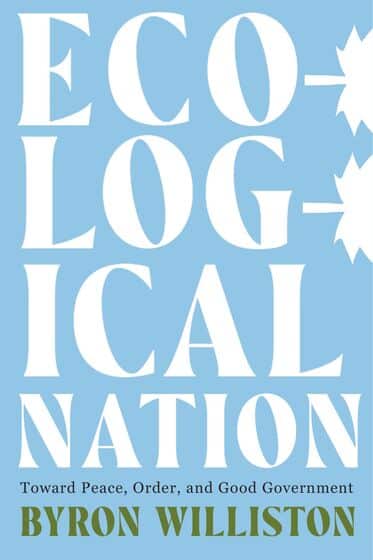
Ecological Nation: Toward Peace, Order, and Good Government, by Byron Williston. McGill-Queen’s University Press, 2026.
What is Canada’s future in the face of two existential threats: the climate crisis and American authoritarianism? Will Canada continue to be a petro-state, or can we transition to a green economy? Byron Williston, who teaches at Wilfrid Laurier University in Waterloo, ON, unpacks these questions in Ecological Nation, a philosophical analysis of the contemporary dilemma for Canadians.
Canada’s Constitution Act of 1867 gave Parliament the nationwide responsibility for “peace, order, and good government”. Williston contrasts this mantra with the foundational phrase in the United States Constitution: “life, liberty and the pursuit of happiness”. This dichotomy between order and freedom can be seen as a source of tension between our two countries.
Canada is today confronted with disorder, both from climate change and from Trumpism. These challenges are intertwined, of course, due to America’s current promotion of fossil-fuel production, the major source of greenhouse gas emissions. In the future, moreover, “climate chaos on the North American continent will motivate actors like Trump to invade our territory if they believe that by doing so they can address concerns of material scarcity at home”.
Williston revisits the insights of George Grant, another Canadian academic, whose Lament for a Nation (1965) bemoaned Canada’s branch-plant status vis-a-vis the USA as a capitulation to the primacy of “technoscience”, inculcating the American dream of freedom and affluence. In the process, Grant argued that Canada’s sovereignty and distinctive culture were being sacrificed. How prophetic this observation, six decades ago, now seems as new threats of annexation are issued from south of the border!
Grant posited that while Canada’s early settlers were animated by Christian morality as a brake on untrammelled freedom, this ethical impulse had withered. Williston takes up that point: “However, we can revivify the value of order without religion because the climate crisis and the rise of authoritarianism have revealed … new challenges.” Pursuing this theme of morality in Ecological Nation, he exhorts Canadians to think as citizens, not just consumers.
Deep decarbonization is urgently required for Canada to reach the international goal of net-zero emissions by 2050. But in a scathing chapter on federal government action (and inaction) on this file, the author demonstrates that “the history of climate policy in this country … is defined by insincerity”: setting unrealistic emission-reduction targets, failing to meet them, using accounting tricks to conceal ineffective measures, subsidizing the fossil-fuel industry, etc. Combating the climate crisis is an ethical imperative: “our failure on this issue will certainly result in exacerbating existing patterns of discrimination against the global poor, Indigenous Peoples, future people, and nature”.
A sincere and pragmatic campaign to achieve deep decarbonization in Canada will require transformative change and some temporary economic pain. Williston argues that any sacrifice will be more palatable if “we face squarely issues of equitable cost sharing among numerous political and social divides”. And policy decisions will need to go beyond strictly economic measures like GDP to include a more holistic assessment of planetary health. In turn this will require a “cosmopolitan vision” that recognizes “planetary boundaries [climate change, ozone depletion, ocean acidification etc.] as universal biogeophysical guardrails”.
The author goes on to declare that the restoration of order and justice in the Canadian body politic must entail “reconciliation with the earth and reconciliation with Indigenous Peoples”. The “majority settler political culture” must engage with Traditional Ecological Knowledge and Wisdom in order to achieve this dual transformation. What can follow is a green Canadian nationalism that transcends historical cleavages (regional, ethnic, religious etc.) and external threats to realize our destiny of peace, order, and good government.
In a rather more ambitious projection of a sustainable global future, the last chapter of Ecological Nation offers a blueprint for the creation of an ecological world order.
Readers of this book will find themselves deep in the philosophical weeds from time to time as Williston makes his case. While his erudition is impressive, it does no harm to skim over some of this academic ballast to reach the core of his argument. A concise Conclusion at the end of each chapter is helpful in this regard.
There is a good deal of wisdom in these pages, although Williston’s prescriptions may seem unduly optimistic. Still, with transformational leadership and growing public awareness of the geopolitical and environmental perils facing us, Canada may yet earn the eco-nation designation.
Ross Thrasher
Ross has enjoyed a 30-year career as a librarian at post-secondary institutions in Canada, the U.C. and the South Pacific. Most recently he served for eight years as Library Director at Mount Royal College in Calgary, leading the library’s transition to university status. In retirement Ross maintains an active interest in literature, travel and the performing arts.
Read more book reviews in GTEC’s Communications & Media section here.