Listen to the author read this article (9:59)
Urban Jungle: The History and Future of Nature in the City, by Ben Wilson. Doubleday, 2023.
Landscape architecture is a ubiquitous component of the urban ecosystem. As Ben Wilson, a British historian, explains in his new book, “We have sought to tame the wildness of nature. Cities allow us to do this. They are relatively segregated from the natural world and become controlled environments in which we can experiment…. The garden in the city signified humankind’s domination…. It was an improved landscape … that appeared to be a spontaneous creation of nature.”
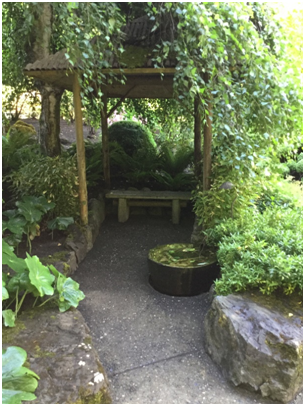 Urban Jungle takes us all the way back to the Hanging Gardens of Babylon in its depiction of historical efforts to incorporate the natural world into the world’s cities. But Wilson argues that many urban parks and gardens, while aesthetically pleasing with their carefully tended lawns, flowerbeds, ornamental trees and shrubbery, presented an artificial and simplistic version of the rural landscape that they were meant to emulate. In the City of London, this rather elitist representation provoked a reaction from the common folk. The Commons Preservation Society, established in 1865, mounted a campaign “for wildness, for the spontaneity of unregulated nature even in the midst of a city. It was an overt criticism of parks, which confined and constricted natural processes and human enjoyment alike. Such attitudes reflected nostalgia for the deep rural past and an awakening appreciation for the beauties of untamed nature …”
Rewilding also takes place in cities damaged by wars and natural disasters. Wilson cites the examples of Berlin, Hiroshima and London, which have seen a return of “vagabond foliage” after those cities were ruined by bombs in World War II. “Disturbance favours biodiversity. In the years after a natural or humanmade disaster, the number of species increases rapidly as plants and insects compete to colonize the barren earth and rubble.” Before long birds and mammals also join this evolving ecosystem.
 The author claims that “biologically speaking, there are no such things as weeds”. But many municipalities have made herculean efforts to eliminate feral plants. “The war against weeds is dauntingly costly in taxpayers’ money and pollutes the wider environment with harmful chemicals…. The despised ruderal plants … sequester carbon and soak up excess rain, … providing ecological services without being asked.” So it behooves us to tolerate, even encourage their incursion into our urban areas.
Wilson devotes a chapter to the enmeshed history of trees and urban areas. Many early cities were established adjacent to forests, which provided food, fuel and building materials. However, “once fossil fuels became the predominant source of energy, the tangible benefits of the nearby forest disappeared and the bond between tree and city was broken”.
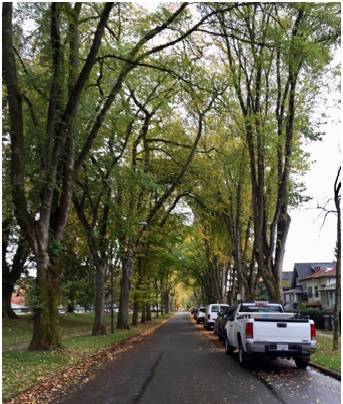
In the meantime millions of trees had been planted within cities, originally for aesthetic reasons along boulevards and avenues, and for comforting shade to counteract the heat-island effect of urban grey infrastructure. “Cities need forests if they are to survive the climate emergency. A forest with thousands of trees releasing moisture into the air is the best air conditioning you can get. Not only do peri-urban forests provide a host of ecosystem services, but they act as a bulwark against sprawl, one of the leading causes of climate change and environmental damage.”
 But around the world, deforestation for agriculture, mining and urban expansion has degraded the watershed upon which cities rely for clean drinking water, and has rendered cities more vulnerable to flooding and landslides.
Reversing the Jungle metaphor of the title to describe the urban riot of concrete, steel and asphalt, Wilson shows how the rapid growth of cities in their engineered defiance of nature has produced an out-of-control tangle of environmental problems. “During the course of the twentieth century, as the global urban population soared, we destroyed 60 per cent of the planet’s wetlands. That precious biome is the fastest-disappearing ecosystem on the planet, going three times faster than forests.”
However, urban planners worldwide have begun to recognize the futility of tearing down, filling in and paving over nature. And thus many cities have embarked on aquatic restoration projects. “Having spent most of their history trying to fill in unwelcome bogs and inconvenient lakes, cities … are battling to make wetlands a central feature of a revived concept of waterscape urbanism.” The author relates several heart-warming accounts of such efforts around the globe. In New York, converting the massive Fresh Kills landfill (a former tidal marsh) into a public park, teeming with wildlife. In Dordrecht, Holland (whose dikes and dams have proven inadequate), recreating a semi-wild shoreline landscape with flood-absorbing catchment areas. In Wuhan, China (which as it grew had filled in most of its urban lakes), re-naturalizing its water features to better cope with heavy rainfall.
 Historically, agriculture has been an integral component of cities, forming a self-renewing ecosystem in the pre-automobile era by recycling rotting plants and horse manure, even human excrement, to fertilize crops. But in the modern city where green space is limited, most food-growing has been moved out to industrial farms using huge quantities of chemical fertilizers, and wastes have been relegated to landfills or flushed away. This disconnection of food sources from urban consumers has given rise to a dangerous environmental problem. “Today, 34 per cent of greenhouse gases and 78 per cent of oceanic and freshwater pollution is caused by food production and distribution…. Rather than being a recycling loop, a modern city commands a one-way flow of nutrients and organic material…. If we collected all the nutrients in domestic wastewater and organic waste, we could fertilize all the crops needed to feed the world’s population.”
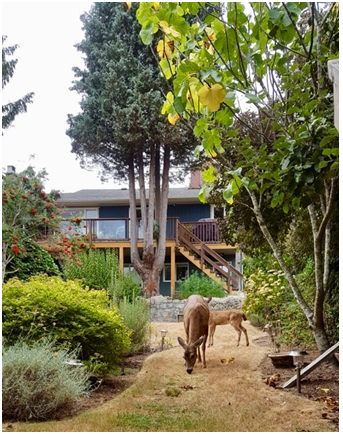
The good news is that urban food production is undergoing a renaissance thanks to rooftop farms, community gardens and allotments, hydroponic farming in disused industrial buildings, and other creative solutions. But most importantly, “coaxing crops out of the bleak concrete adds biodiversity and greenness to cities”. The migration of bees, birds and animals into re-greening urban areas, while sometimes seen as a nuisance or even a public-health hazard, is a positive development according to Wilson. “The success of wildlife in urban landscapes is surely a sign of a healthy city.”
 Urban Jungle concludes with brief descriptions of a few lost urban civilizations in human history — the Mayans of Central America, Angkor in Southeast Asia, the ancient Akkadian Empire of Mesopotamia. What did these disappearing city-states have in common? The archaeological and meteorological evidence is incomplete, of course, but it appears that a changing climate may have played a role, exacerbated by deforestation and over-farming. Prolonged human conflicts have also led to societal dismemberment. Clearly, in the author’s view, the survival of modern-day mankind will depend on our ability to make our great grey cities green and blue again.
 Ross Thrasher has enjoyed a 30-year career as a librarian at post-secondary institutions in Canada, the U.S. and the South Pacific. Most recently he served for 8 years as Library Director at Mount Royal College in Calgary, leading the library’s transition to university status. He maintains an active interest in literature, travel and the performing arts. Especially satire.